


I was listening to Jimmy Carr on a podcast recently, and something he said stuck with me:
Your life does not need to be easier. It needs to be simpler. Your system is designed to handle stress and challenge but not complication. You probably handle hard things pretty well but feel overwhelmed when they become messy. Do not attribute to difficulty that which can be explained by complexity.
For much of my life I’ve conflated difficulty and complexity.
Early in my career, I was building a system that processed work in batches.
Five hundred items would arrive together in a request, and my task was to decide what happened when something went wrong. There were so many failure modes.
Sometimes the batch request itself was bad. Sometimes a single item out of 500 failed, which raised the question of what to do with the 499 that succeeded. Retrying everything meant redoing work that had already been done. Retrying only the failure meant tracking partial completion forever, which added so much more scope to the project. My head was swimming in edge cases.
The design that I finally shipped did almost nothing. When a batch hit trouble, the system marked it as stalled, then it generated a report and alerted a human, who would take it from there.
Confusing hard and difficult is an issue. Why? Because the two types of problems should be handled in opposite ways.
When something is hard, putting in more effort is the right move. When something is complex, more effort will merely compound the problem.
When we describe something as being “too hard,” more often than not, we’re talking about something that is too complicated.
Put those two properties on their own axes, and we get an interesting spread:
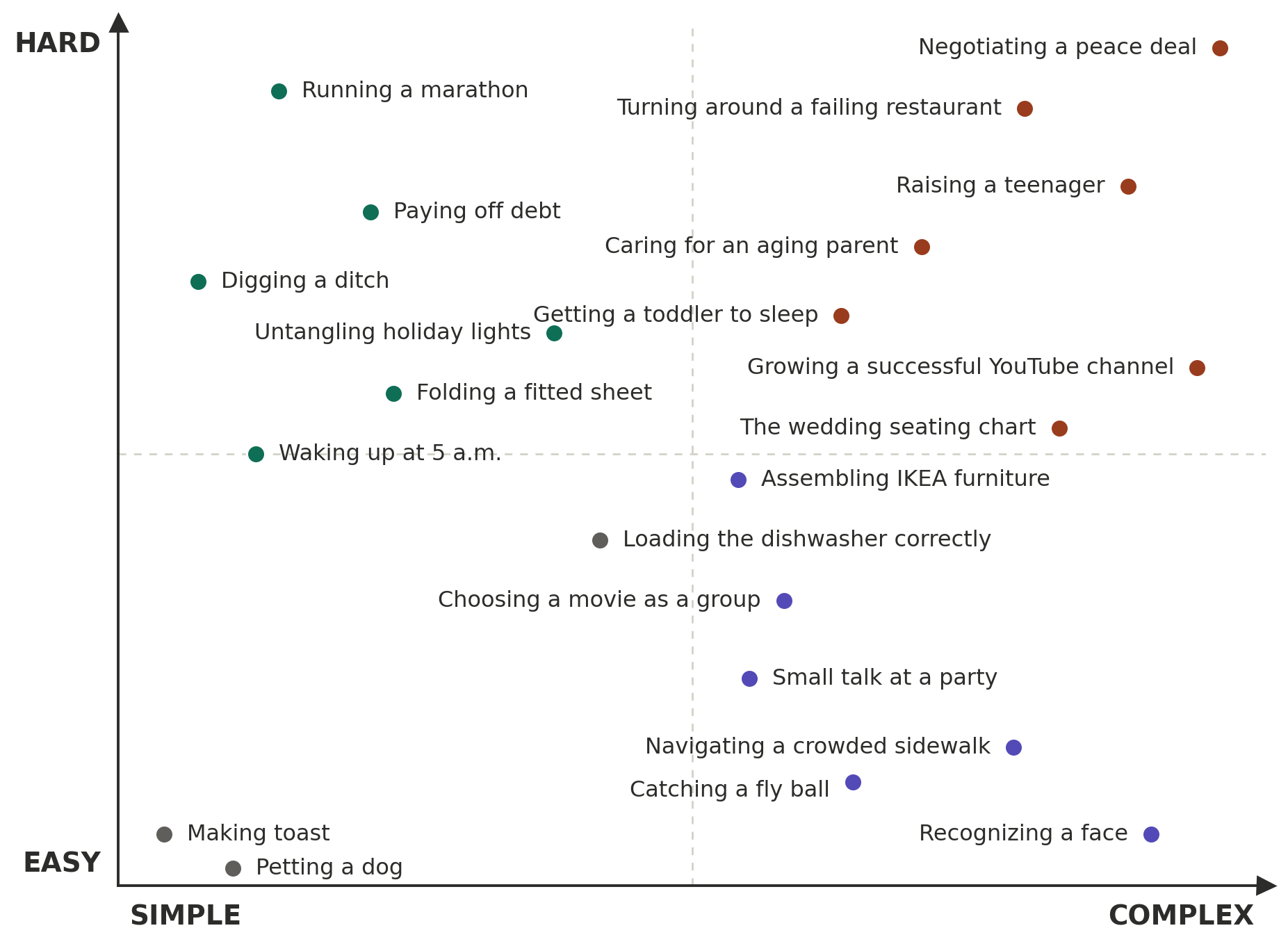
The top left is the grind quadrant. The solution is to put in more work. You can win by doing more. It may be uncomfortable, but it’s not confusing.
The bottom right corner is interesting. Navigating a crowded sidewalk requires you to predict what a dozen strangers are going to do all at once, and you can do it without a single thought.
The top right is where burnout happens if we keep trying harder.
I spent almost twenty years building software at Amazon, and the biggest lesson about scaling is captured in Carr’s quote. Systems scale when each step stays simple. The services that can help Amazon survive a Black Friday are the ones that aren’t complicated. Each component should do only one small but important thing.
Complexity is the enemy of scale.
The same goes with our careers. We should grow our careers by putting in hard work but also by minimizing the number of things we do at any given time.
When we’re overwhelmed, we wish life were easier. But overwhelm comes from too many things that depend on too many other things in a complicated web where you don’t know where to begin, not from the difficulty of any one item.
This week’s exercise is to draw your own graph. Draw two axes on a piece of paper: easy to hard and simple to complex. Plot everything at work and in life that’s weighing on you. If you’re unsure where something goes, ask yourself a question: If I just kept showing up and doing the work, would it eventually get done? If your answer is yes, it’s hard. If more work wouldn’t make a dent, or the situation keeps shifting underneath you, it’s probably complex.
The stuff on the left of the graph can be solved with effort, so give it effort.
The stuff on the right is different. The goal there is to stop working harder.
Start by asking whether it can be made simpler. It usually can, and the approach often looks like my batch system: lower your ambition for what the solution has to cover. Handle the common cases well, and let a person or a rule catch the rest.
However, some things can’t be made simpler. Raising a teenager will never have fewer moving parts. Neither will caring for an aging parent. For those, the honest move is acceptance. Extra effort won’t untangle them. The best you can do is respond to what comes and let go of the idea that there’s a neat solution.
The next time something feels too hard, take a second look. If it’s hard, push. If it’s complex, simplify what you can and make peace with what you can’t.
Sometimes the best advice is simple.
Enjoyed this week’s newsletter? Give it a ❤️ so I know to write similar ones in the future.
Tech Salary Negotiation Masterclass | Colin Lernell
Most engineers think their pay reflects their performance. Colin Lernell watched the worst performer on his team earn $120K more than the best, and that one observation changed everything.
Now one of the world’s foremost experts in tech salary negotiation, he sits down with me to break down the secret menu that most candidates don’t even know exists, why you don’t need a competing offer to negotiate, and how to get one of those $2M to $7M AI compensation packages even if you’re not an AI expert.
Loved it Steve!! You gave me clarity today. Thank you ❤️
But what if it’s both? 😅
(Mostly kidding. Mostly.)